

Facet joint procedures particularly radiofrequency ablations (RFAs) are a core part of many pain practices. However, RFAs don’t stand alone in the prior authorization process. They are directly dependent on diagnostic medial branch blocks (MBBs), and any weakness in MBB documentation almost always shows up as an RFA denial downstream.
In fact, 25–30% of RFA prior authorization requests are denied on the first submission. These denials are rarely about the procedure itself. Instead, they stem from documentation gaps earlier in the workflow: missed imaging, insufficient conservative care records, unclear pain relief percentages from blocks, or incorrect timing between procedures.
In the third video of our educational series, we turn our attention to facet joint procedures, focusing on radiofrequency ablation (RFA) and why clean, consistent documentation from medial branch blocks is essential for approval.
We also share three practical, workflow-focused tips that help reduce first pass denials and make RFA prior authorization more predictable and easier to manage
Why RFA prior authorization is so closely tied to Mbbs
RFAs are always preceded by two diagnostic medial branch blocks. From a payer’s perspective, these three procedures MBB #1, MBB #2, and RFA are tightly linked.
| Need help tightening your MBB and RFA workflows? Our team works with pain practices to review documentation, align prior authorization submissions, and reduce denials for high scrutiny procedures like RFAs. Talk to our team | Request a workflow review Call us at: (512 ) 868 1762 |
RFA approvals are entirely dependent on how well the MBBs are documented. If documentation is incomplete or inconsistent at the MBB stage, RFA authorizations and even downstream claims become significantly harder to secure.
Three high impact tips to improve RFA prior authorization success
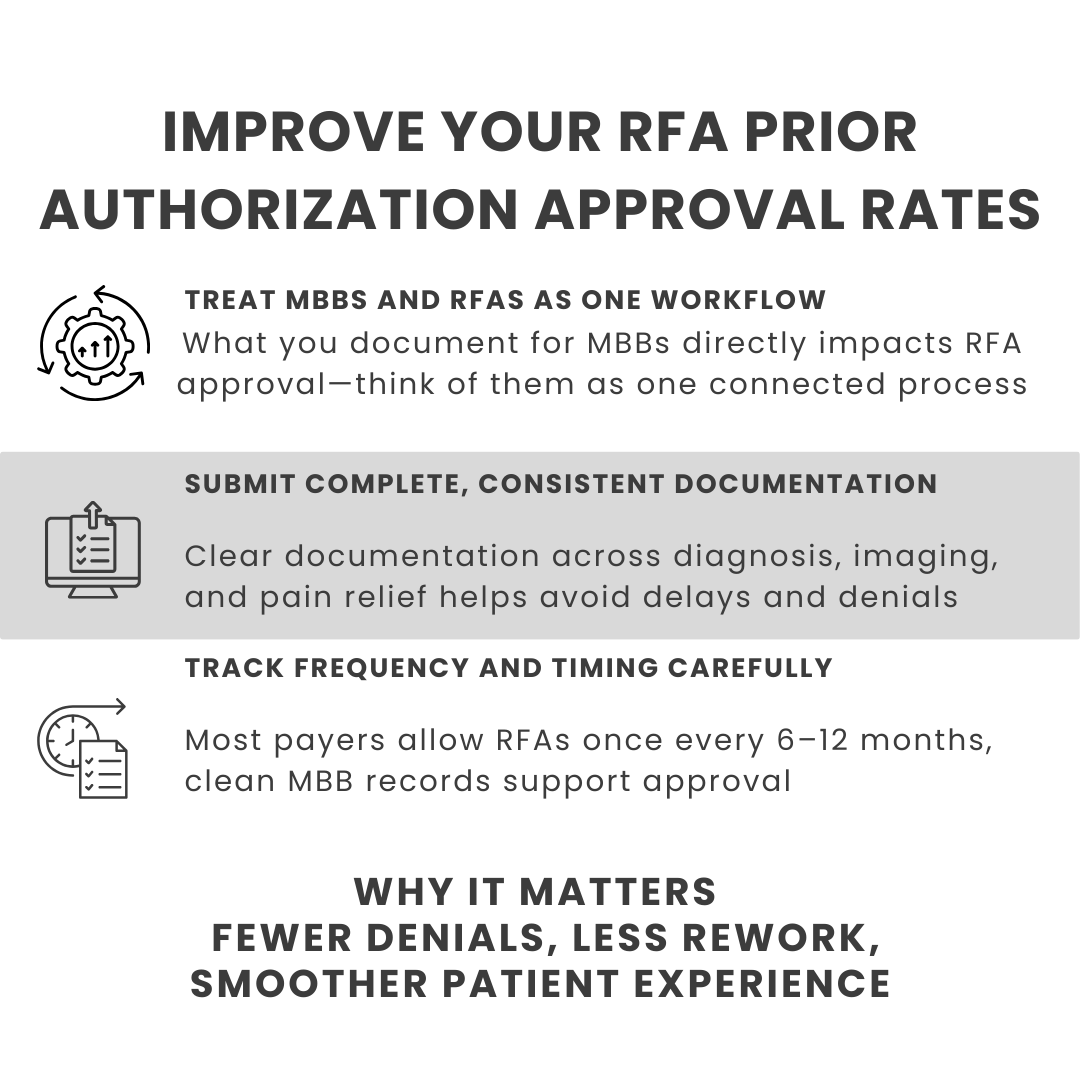
Step 1: Treat MBBs and RFAs as one continuous workflow
One of the most common mistakes practices make is treating each step: first MBB, second MBB, and RFA as separate events. In reality, they should be handled as one single workflow.
Any documentation required for the first MBB including conservative care history, imaging, pain diagrams, and baseline pain scores will also be required for the second MBB. That same documentation, along with clearly documented pain relief percentages, is then required for the RFA prior authorization.
Thinking about all three procedures together and preparing documentation accordingly reduces gaps and prevents avoidable denials later in the process.
Step 2: Ensure all required documentation is complete and precise
Before moving forward with MBBs or submitting an RFA prior authorization, make sure the following documentation is fully in place:
A clear diagnosis of facet-mediated pain, without untreated radiculopathy
- Imaging, when required, to rule out radiculopathy or alternative pathologies
- Documentation of all conservative care tried, along with outcomes
- Pain relief percentages from both diagnostic blocks, typically ranging from 50–80%, though most payers require at least 80% relief
- Pain scores documented before and after each block
A critical documentation tip shared in the episode:
Post-block pain scores should be recorded while the patient is still on the table. Pain relief from medial branch blocks is almost instantaneous, and on-table documentation is considered the most accurate and is often preferred by payers.
Step 3: Pay close attention to frequency and timing
Frequency limits and procedural intervals are another major source of RFA denials.
Most insurers:
- Limit RFAs to one procedure every 6–12 months
Careful attention to MBB timing, relief documentation, and overall sequencing makes RFA prior authorization and claims processing downstream much smoother. When intervals are missed or poorly documented, even clinically appropriate RFAs are likely to be denied.
| Reduce denials and simplify RFA approvals with a clinic-ready checklist. Download our RFA & Medial Branch Block Prior Authorization Submission Checklist to help your team submit clean, complete authorizations and avoid downstream delays. |
Why optimizing the RFA prior authorization process matters
When RFA prior authorization workflows are not managed carefully, practices face:
- Higher first-pass denial rates
- Increased administrative rework
- Delays in patient care
- Revenue disruption tied to downstream claims
RFAs may be common procedures, but payer scrutiny is high. Tight documentation and workflow discipline starting at the MBB stage are essential for success.
RFAs and medial branch blocks are not separate authorization events, they are part of a single, interconnected process. The quality of your MBB documentation directly determines how smoothly RFA approvals and claims move forward.
| Watch the video here |
The guidance shared in this episode is intended to help practices reduce preventable denials, create consistency across procedures, and improve both operational and financial outcomes.
Author
Kalyan Yamijala, COO and Co-founder: PainMed-PA
Kalyan Yamijala has spent over 25 years at the intersection of healthcare and technology. As a founder of a healthcare technology and revenue cycle management company, he’s passionate about creating smart solutions that make medical billing simpler, streamline revenue processes, and ultimately improve patient care.